Advanced UAV Integration in Mineral Exploration: Methodologies, Payloads, and Structural Workflows
For decades, terrestrial mineral exploration has relied heavily on manual field mapping and ground-based geophysical surveys—processes inherently constrained by topographical barriers, high labor intensity, and prolonged data acquisition cycles. While conventional satellite remote sensing and manned airborne surveys offer macro-scale alternatives, they often present compromises in either spatial resolution or operational cost-efficiency.
As an innovator in industrial automation and intelligent tech solutions, HongKong Global Intelligence Technology Group Limited examines how Unmanned Aerial Vehicle (UAV) platforms are bridging these operational gaps, transforming modern geoscientific surveys through high-resolution, multi-sensor data acquisition.
1. Addressing Operational Constraints in Conventional Exploration
Traditional ground and airborne exploration frameworks routinely encounter three critical bottlenecks:
Topographical and Logistic Access: High-grade mineralization often occurs in rugged, high-altitude alpine zones, dense vegetative canopies, or remote terrains where ground-based cross-country traversing poses substantial safety risks and operational delays.
Data Resolution and Surface Obscuration: Satellite imagery often lacks the spatial resolution required for localized structural mapping, while dense undergrowth frequently conceals critical surface expressions of hydrothermal alteration from conventional optical sensors.
Capital Expenditure and Scale: Manned airborne geophysical surveys demand substantial mobilization costs, specialized aviation fuel, and extensive regulatory clearances, rendering low-altitude, high-density surveys cost-prohibitive for targeted, mid-scale exploration programs.
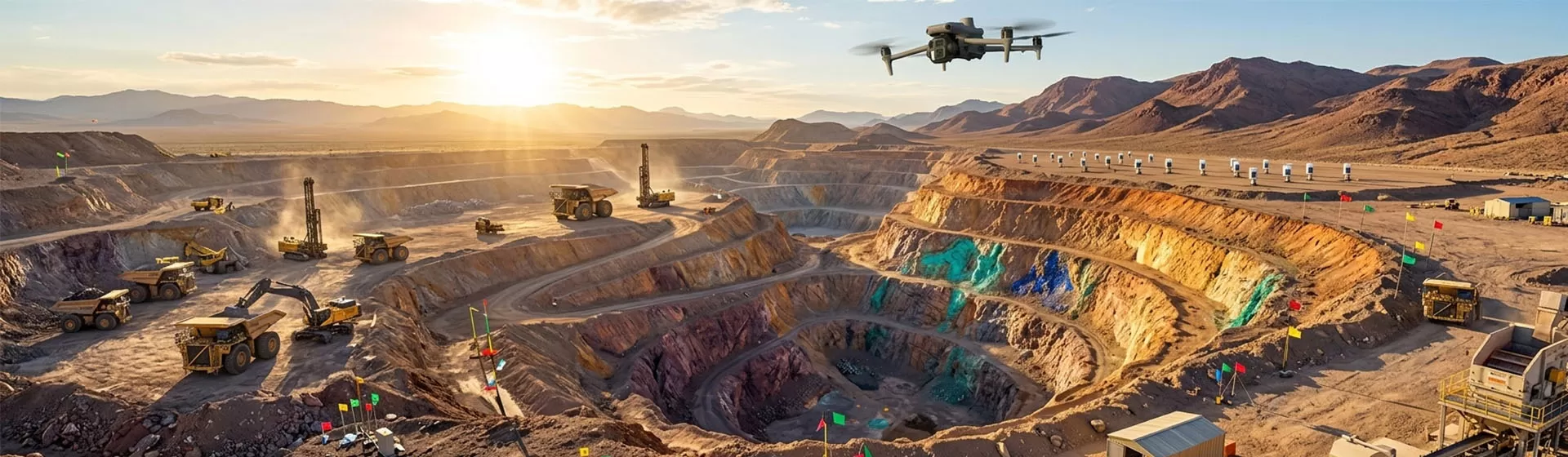
UAV technology mitigates these constraints by serving as an agile, low-altitude, low-velocity platform capable of deploying advanced geophysical and remote sensing payloads beneath cloud covers and closer to the geologic targets.
2. Sensor Payloads and Geophysical Data Acquisition of Drones
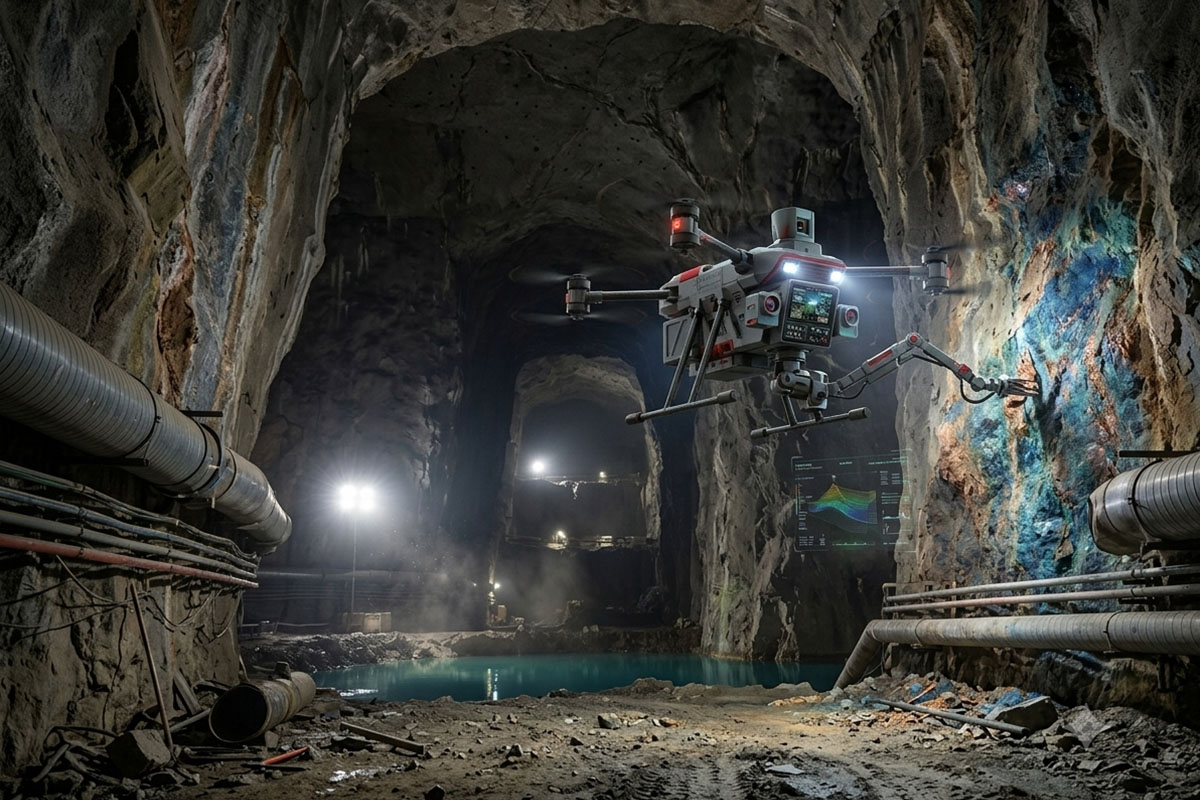
The efficacy of UAV-based exploration resides in the integration of specialized sensor payloads designed to map subsurface physical anomalies and surface mineralogical characteristics.
UAV-Borne Magnetic Surveys (Aeromagnetics)
Subsurface mineral systems—particularly magnetite-rich iron deposits, nickel copper sulfides, and structurally controlled porphyry systems—frequently exhibit distinct magnetic susceptibilities. Ming Dronesequipped with ultra-lightweight optically pumped cesium or fluxgate magnetometers conduct high-density, low-altitude grid flights. The resulting total magnetic intensity (TMI) data allows geophysicists to model structural lineaments, shear zones, and subterranean intrusive bodies with high spatial fidelity.
Hyperspectral Remote Sensing
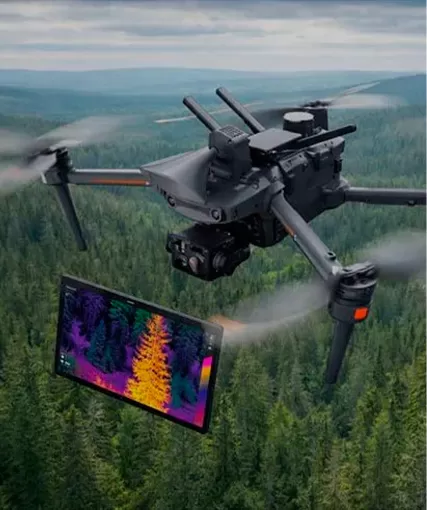
Hydrothermal alteration minerals (such as kaolinite, illite, alunite, and iron oxides) display unique diagnostic absorption features within the Short-Wave Infrared (SWIR) and Near-Infrared (NIR) spectrums. UAV-mounted hyperspectral imagers capture continuous spectral bands, allowing geologists to execute pixel-level spectral unmixing. This maps surface alteration zoning patterns, providing direct vectoring indicators toward potential mineralization centers.
Airborne Airborne LiDAR (Light Detection and Ranging)
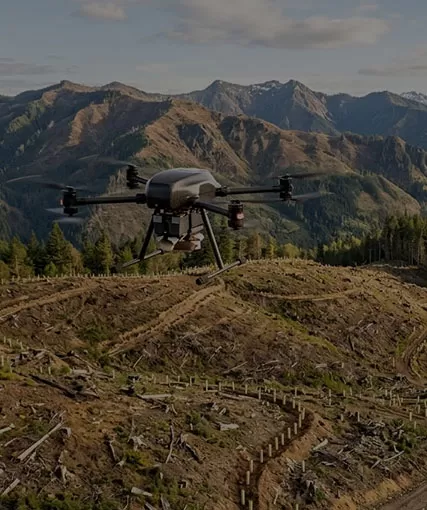
In terrains characterized by dense vegetative cover, standard optical photogrammetry fails to capture true ground morphology. LiDAR payloads emit high-frequency laser pulses capable of penetrating canopy gaps. Through advanced point-cloud classification and filtering algorithms, the vegetative layer is digitally stripped away to generate a high-precision Digital Terrain Model (DTM), exposing subtle fault scarps, joints, and lithological contacts that govern ore deposition.
Multi-View Oblique Photogrammetry
Utilizing multi-camera arrays, indusytial drones capture high-overlap imagery from nadir and oblique angles. Computational stereophotogrammetry processes these datasets into georeferenced, centimeter-scale 3D Digital Twins of outcrops, open pits, and steep valley walls, enabling remote structural geological mapping and structural orientation measurements (dip and dip direction).
3. UAVs Standardized Operational Workflow: Data Lifecycle
A rigorous UAV exploration program follows a systematic, data-driven workflow divided into four primary technical phases:
UAV Standardized Operational Workflow
Data Lifecycle
FLIGHT PLANNING → ACQUISITION → PROCESSING → INTEGRATION
STAGE 01
Terrain-Following Path Design
Flight path generated against DEM/DSM to maintain constant AGL altitude over variable terrain.
→
STAGE 02
Synchronized Field Acquisition
Time-synced multi-sensor data capture across UAV platform during mission execution.
→
STAGE 03
Geophysical Data Processing
Raw signal correction, noise filtering, and inversion to derive calibrated geophysical datasets.
→
STAGE 04
Multi-Data GIS Integration
Fusion of processed layers into a unified spatial database for analysis and visualization.
4 STAGES — LINEAR SEQUENCE
Terrain-Following Flight Path Design: Using prior coarse Digital Elevation Models, flight paths are configured with adaptive algorithms allowing the UAV to maintain a constant, pre-determined altitude above the ground surface (AGL). This ensures uniform sensor resolution and signal-to-noise ratios over rugged topography.
Synchronized Field Acquisition: The UAV executes autonomous flight paths while concurrently, a stationary ground base-station magnetometer records diurnal variations of the Earth's magnetic field. This baseline continuous data is essential for mathematical drift correction during post-processing.
Geophysical Data Processing and Quality Control: Raw telemetry and sensor outputs undergo radiometric calibration, geometric correction, and tie-line leveling. Noise filtering algorithms remove spatial high-frequency noise and diurnal magnetism spikes, yield-ing clean, standardized datasets.
Multi-Data GIS Integration and Target Generation: Geophysical (magnetic anomalies), geochemical/mineralogical (hyperspectral alteration maps), and structural (LiDAR lineaments) data layers are co-registered within a unified Geographic Information System (GIS) environment. The convergence of these independent geological criteria defines highly prospective exploration targets for subsequent exploratory drilling.
4. Architectural Shift Toward Intelligent and Quantitative Mining
The deployment of UAVs in mineral exploration represents a qualitative shift from traditional, localized sampling to systematic, regional-scale data analytics. By acquiring high-resolution datasets across hazardous or inaccessible sectors safely and at a lower cost per line-kilometer, UAVs have become an essential component of modern, multi-disciplinary exploration frameworks.
HongKong Global Intelligence Technology Group Limited continues to track and support the technological convergence of advanced robotics, UAV systems, and AI-driven geological data processing, delivering robust, automated solutions designed to enhance accuracy and operational efficiency across global industrial applications.
Corporate Profile
HongKong Global Intelligence Technology Group Limited focuses on the integration and industrial deployment of advanced automation, intelligent sensor systems, and enterprise data analytics, driving technological optimization for global industrial sectors.

 English
 français
 Deutsch
 русский
 فارسی
فارسی ไทย
ไทย العربية
 Nederland
 বাঙালি
 Македонија