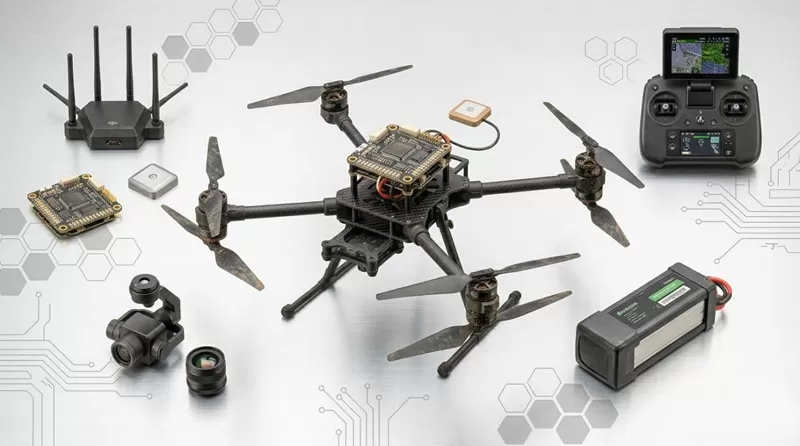
If you've worked with more than one industrial drone platform, you'll know that spec sheets rarely tell the full story. Two drones may list similar payload capacity or flight time, yet behave very differently in the field. The difference usually comes down to how well the drone parts and drone components are engineered—and more importantly, how they work together as a system.
This guide takes a practical look at drone hardware from an application perspective, not just a checklist of parts—while also reflecting how platforms like those developed by ZAi approach real-world deployment.
At the structural level, the airframe is not just about shape—it dictates how the drone handles vibration, load stress, and environmental exposure. Industrial drone airframes are typically built with carbon fiber composites, but design geometry (foldable vs. fixed, coaxial vs. flat layout) has a direct impact on transportability and stability under load.
The propulsion system—motors, propellers, and ESCs—needs to be evaluated as a matched set. High-thrust motors alone don't guarantee performance. Efficient propeller pairing and responsive ESC tuning are what give an industrial drone smooth control, especially when carrying uneven or dynamic payloads.
The flight controller is where integration starts to matter. Beyond stabilization, modern controllers manage redundancy logic, sensor fusion, and autonomous workflows. In platforms like ZAi's industrial drone systems, the flight stack is typically optimized alongside the hardware to ensure predictable behavior under mission stress, rather than relying on generic configurations.
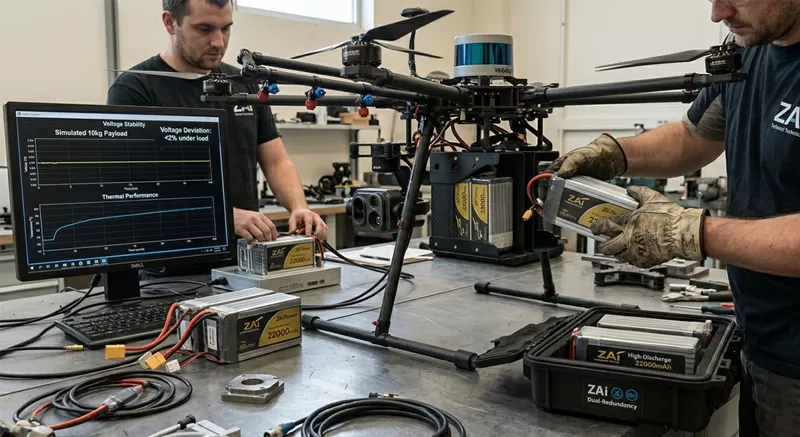
Flight time figures are often highlighted, but for real operations, power consistency is just as critical. Voltage drop under load, thermal performance, and discharge curves all affect how reliable a drone is during demanding missions.
Well-designed industrial drone platforms address this by:
Using high-discharge batteries optimized for heavy payload scenarios
Supporting dual-battery redundancy for critical operations
Allowing fast battery swaps to reduce downtime in continuous workflows
ZAi, for example, tends to emphasize stable power output under load in its heavy-lift configurations—an approach that prioritizes mission continuity over headline flight time.
Positioning and awareness systems are what turn a flying platform into a usable tool. GNSS modules with RTK capability are now standard in many industrial drone solutions, but their effectiveness depends on integration quality and environmental conditions.
Beyond positioning, sensor stacks typically include IMUs, barometers, and increasingly, obstacle detection systems using LiDAR or computer vision. What’s often overlooked is how these inputs are fused. Poor sensor fusion leads to drift, lag, or unstable hovering—issues that don’t show up in brochures but quickly appear on-site.
For applications like inspection or mapping, precision and repeatability matter more than raw sensor specs—something consistently reflected in how ZAi structures its drone solutions for enterprise users.
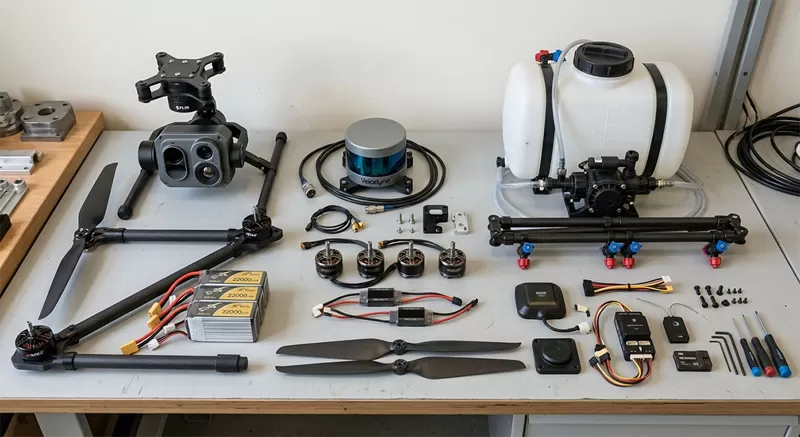
Payload capability is where differentiation between platforms becomes obvious. It's not just about how much weight a drone can carry, but how cleanly it integrates that payload.
A mature industrial drone system will offer:
Standardized mounting interfaces
Dedicated power outputs for payloads
Seamless data communication between payload and ground station
Whether it's a thermal camera, LiDAR unit, or spraying system, integration quality affects everything from flight stability to data accuracy. ZAi's modular approach to payload integration reflects a broader industry shift toward multi-mission platforms rather than single-purpose builds.
Reliable communication is often underestimated until it fails. Industrial drone operations depend on stable data links for both control and telemetry.
Typical systems include dual-band transmission, long-range antennas, and encrypted channels. However, the real value lies in how the ground control software presents and manages that data. A well-designed interface reduces operator workload and improves decision-making in real time.
For enterprise deployments, interoperability with existing infrastructure—cloud platforms, command systems, or fleet management tools—is increasingly a baseline requirement, and a key focus area in ZAi's broader drone solutions offering.
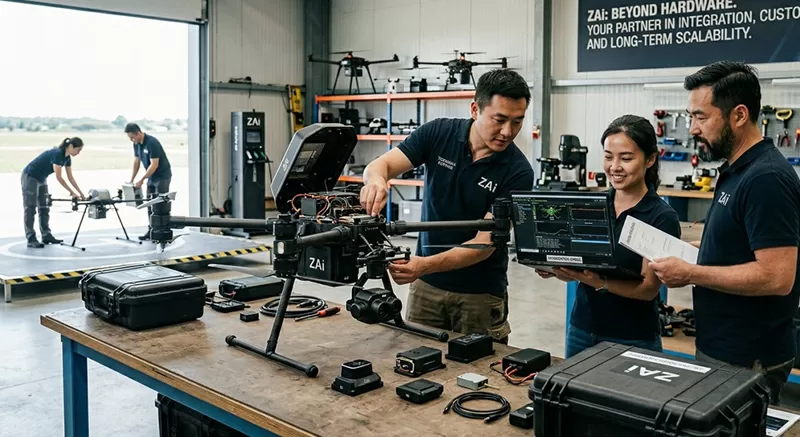
Hardware alone doesn't define a successful deployment. The ability of a drone manufacturer to support integration, customization, and long-term scalability is just as important.
Look beyond specifications and consider:
How adaptable the platform is to different payloads
Whether firmware and software are regularly updated
The availability of technical support and customization options
An experienced drone manufacturer—such as ZAi—typically positions itself not just as a hardware provider, but as a partner in building application-specific drone solutions.
In practice, no single component determines performance. The airframe, propulsion system, sensors, and software stack all interact in ways that either enhance or limit the overall system.
That's why evaluating drone parts in isolation can be misleading. A well-integrated industrial drone, supported by a capable drone manufacturer like ZAi, will consistently outperform a platform with stronger individual specs but weaker system design.
For businesses investing in drone solutions, the goal isn't just to understand the hardware—it's to understand how that hardware performs when it matters—under load, in complex environments, and across real operational cycles.